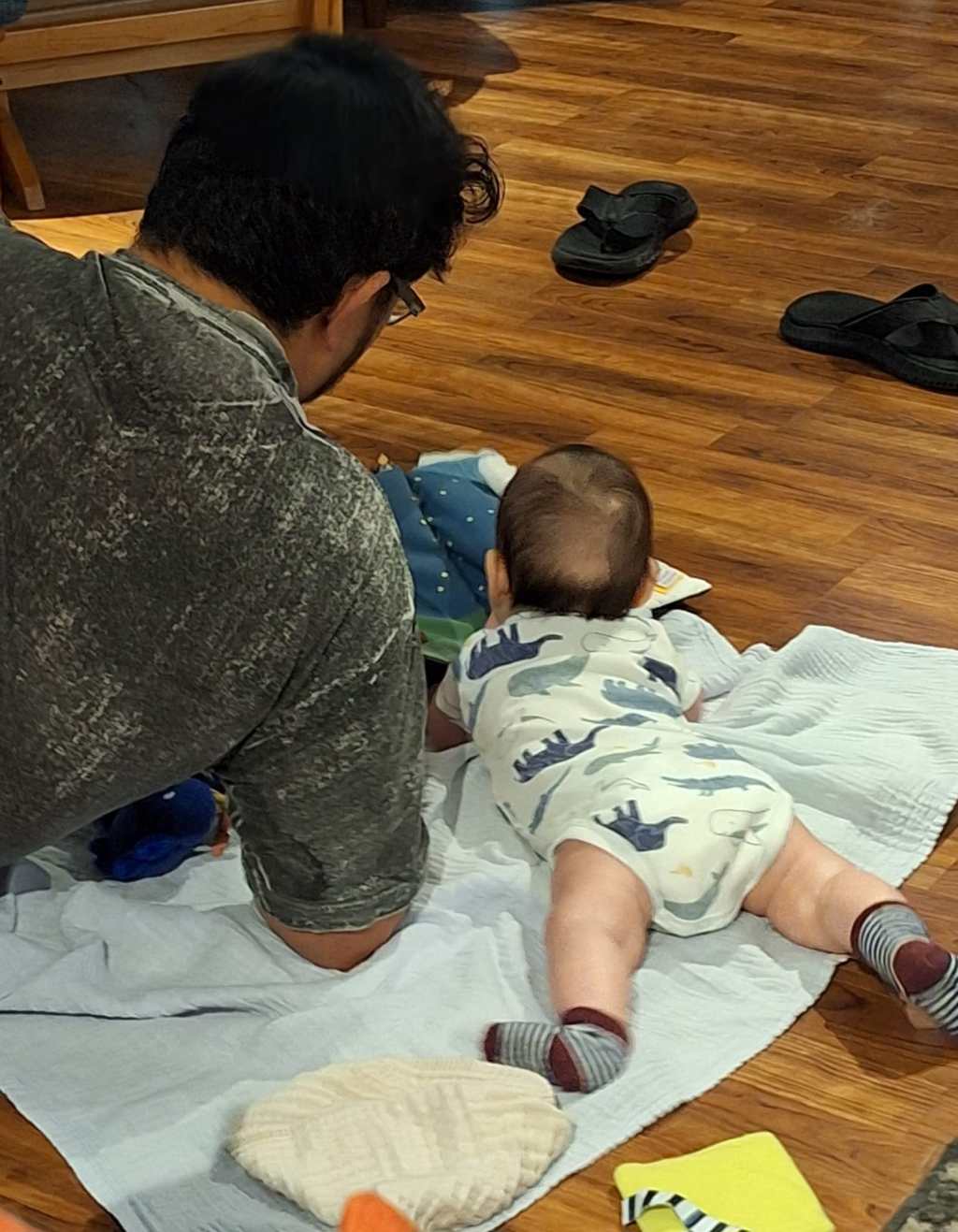
Before my son was born, I knew that I would be one of those moms who read to her kids early and often (aka every day). It would be easy, right? I mean, especially when they’re super little and not mobile.
Yet on the questionnaires for my infant’s wellness checks, one question asked how many days in the past week someone in the household had read to the child, and I was surprised that my answer was far lower than my assumed goal of “every day.”
I’m a teacher after all, and I know the importance of reading every day for both language acquisition and for establishing foundational skills for future reading ability!
So I decided to get a little creative with how I incorporated books into his young life. I thought I’d offer up some of the ways I’ve read to my little guy during his first year of life outside of the womb. I hope to inspire other parents of babies to incorporate more reading into their everyday lives.
First, here are a few “rules” – really guidelines – for helping your child learn to love to read from a young age. I have these in the back of my head as I’m exposing my baby boy to books and concepts of print.
Rule #1: Don’t force it! Even if you only read a page at a time before your baby loses interest and closes the book, it’s okay.
Rule #2: Make it fun and interesting by varying your voice! Who wants to listen to someone read a book in a monotone voice? Definitely not me. So I make the voices different and put emotion into it. Be an actor/actress. Your kid(s) will LOVE it, I promise, and then you’ll keep doing those types of things to earn more of their smiles and giggles.
Rule #3: Keep books everywhere and within easy reach for you and for your baby. Also, rotate what books are out on the floor to keep their interest. I’ve ended up having books in every room, and his books are on low shelves so that they’re easy to reach for him (and so my books are out of his reach).
Here are the five ways that I’ve read to and with my little guy in his first year.
Disclaimer: None of the references to tummy time or other developmental stages can be considered medical advice. I am a teacher and mother, not a doctor or expert on babies’ development.
Before Baby Can Roll Over (approx. 0-5 months)
1. On Your Backs
I found it difficult when he was first learning to hold up his own head to figure out how to help him see the pictures.
I tried holding the book in front of us while he was leaning against my chest, but it was too difficult to balance him, hold the book, and turn the pages at the same time.
I also tried laying him on the floor and sitting near him, but I couldn’t get a good angle to let both of us see the book simultaneously.
So one day, when he was lying on his back, I got down on my back right next to him and held the book open above us and read it to him. He loved it – probably because it was like an interesting type of mobile to him.
I did have to take a break for my arms if I read a longer picture book to him, but for a short board book, it worked great. He also particularly enjoyed Blueberries for Sal and Make Way for Ducklings.
2. On Your Tummies
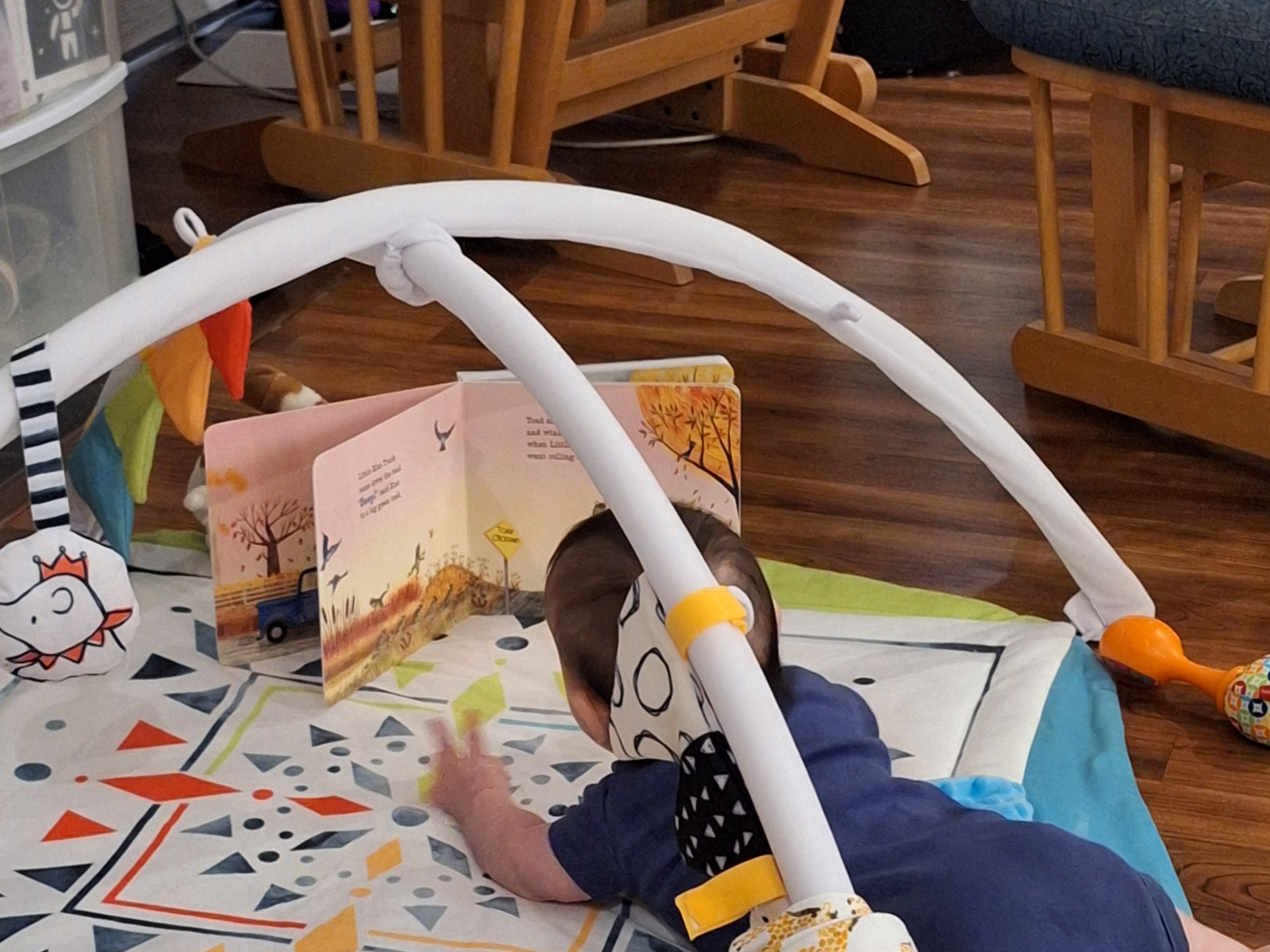
Babies do not always love tummy time in the first few months. Mine was one of those.
I found that holding open a board book so it was in front of him on the floor helped him be able to see it and gave him something to focus on. I also adjusted its position if he took a rest and laid his head on the floor. I then got on my own tummy and read it to him.
This mainly happened after he was a couple of months old, because before then, tummy time lasted for all of a couple of minutes.
Bonus: baby looks at a book on his/her own
I loved doing this. When little man was on his tummy or his back and I needed to be able to step away for a moment – for a drink of water or to talk to someone else in the room, I propped open a book on the floor in the same manner as above.
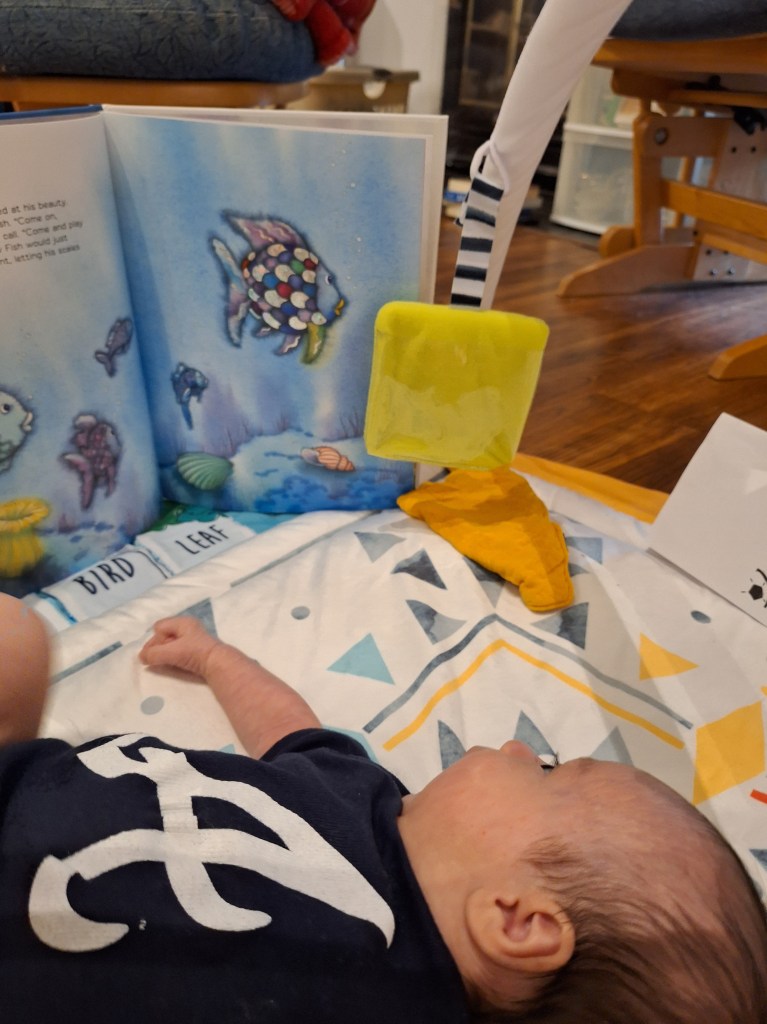
I figured that it was great for him to be able to look at the pictures uninterrupted for far longer than I’d want to stay on the page if I were reading the book.
Then, after I’d come back from getting water, I’d turn to another page. I often chose a book that we’d already read together, like The Little Blue Truck or a touch and feel book like That’s Not My Dinosaur!.
The other reason standing the book up like this made sense to me was that many experts suggest giving babies increasingly complex black and white images to look at when they’re in their crib, on their tummy, on their back, etc. I figured once he was graduating to color, putting book illustrations in front of him was the next logical step!
After baby can roll over (approx. 5-12 months)
Once baby is starting to explore the world a bit more, it might be harder to get him or her to stay still long enough for an entire book – even with how short baby books are.
That is okay!
Remember, you’re not trying to force a specific way of reading; you’re just building reading into his or her life so books and reading are a given.
3. Read when Baby is Low Energy
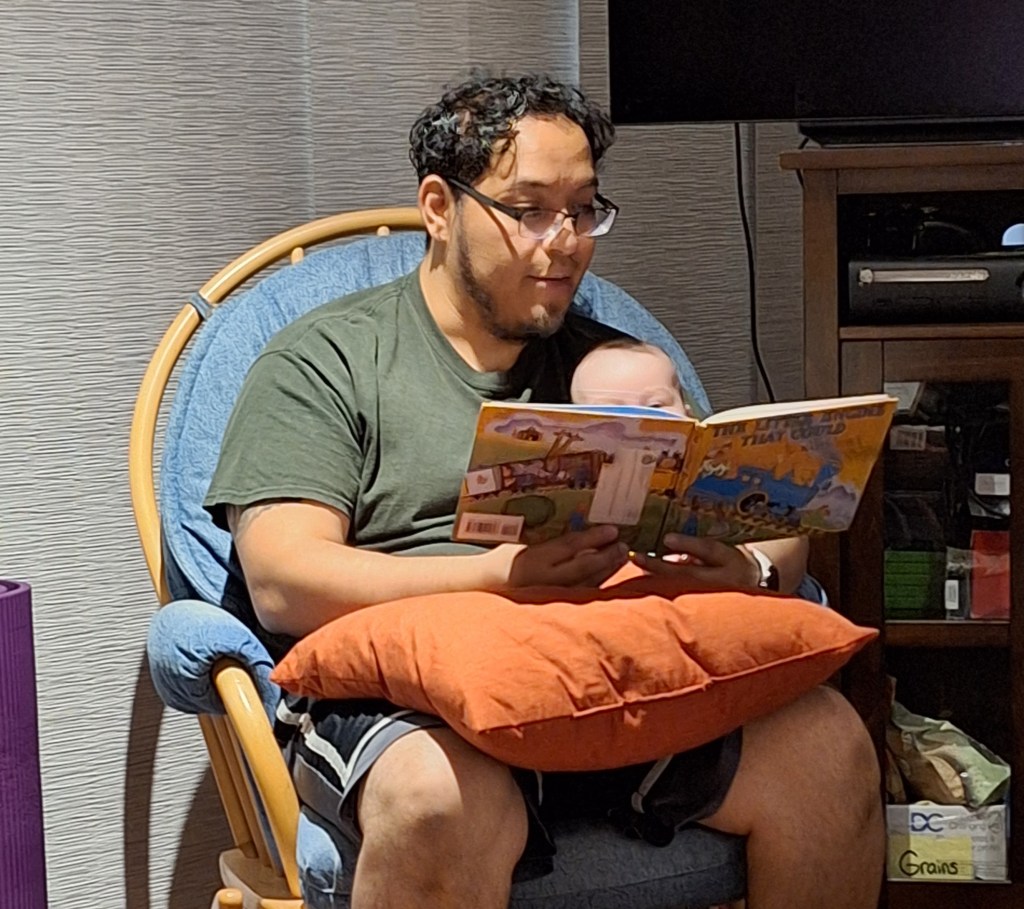
Reading when baby’s energy is low increases the chance that he’ll sit still and look at the book while I read it. Again, it’s okay if he doesn’t, but I find it more interesting for myself if we actually do get to read a whole book in one sitting. Therefore, I try to take advantage of when he’s not rocking and rolling all over.
In our house, we don’t always read right before bed. I know many people use reading as part of their bedtime routine, and I think we will more and more the older he gets.
However, in this first year of his life, there have been so many times when we realized that he just needed to go to sleep now because we’d missed his sleepy cues. Making reading a part of the sleep time routine was NOT worth the meltdowns that would have resulted!
Therefore, we have tried using it as a winding down strategy. If we’re going from giggles and tossing him in the air, and all of a sudden he starts to rub his eyes, I know that he needs a transition to get from giggles to sleeping. He won’t be able to do it in the two minutes it takes to turn off the lights and put him in his sleep sack. (Would you?)
So I’ll try sitting with him in our glider and reading a low-energy book. If he leans against me and sits still for even half of the book, I consider that a win. It doesn’t always work, but when it does, it’s satisfying.
4. Practice sitting up on the Floor
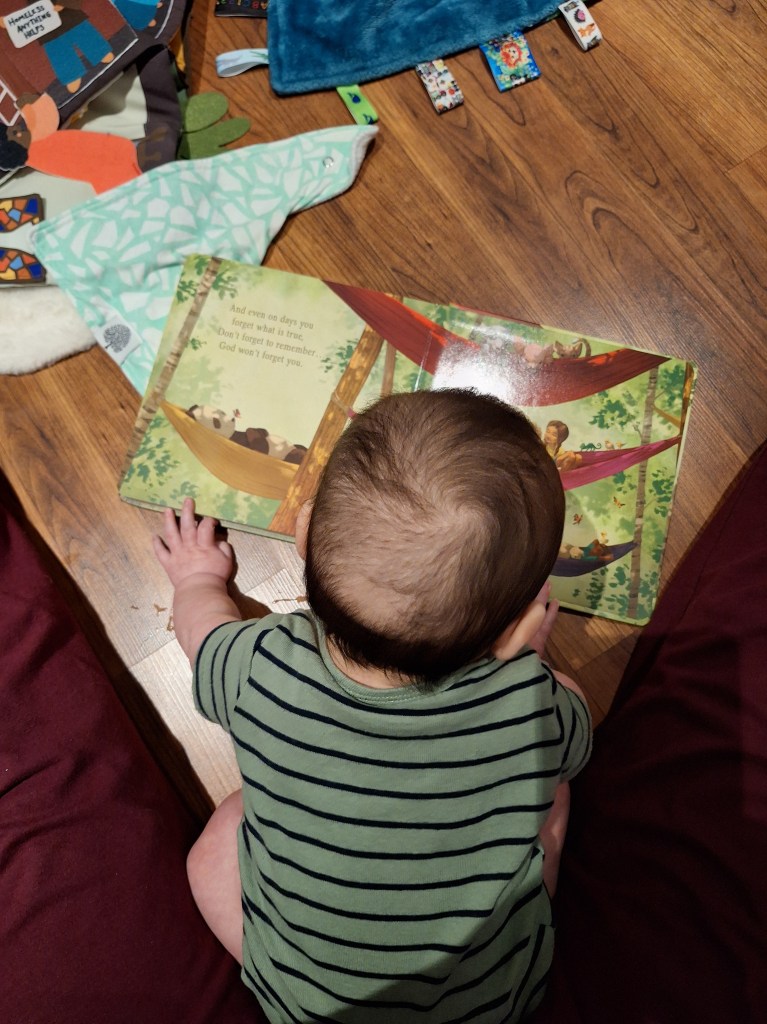
When baby is in the “tripod” stage of sitting, where their hands have to be on the floor to prop them up, it’s the perfect opportunity to put a book down in front of them, sit behind them for extra support, and read.
If your kid is like mine, they’ll end up balancing with one arm and using the other to swipe at the pages. But you can still get a good chunk of the book read. Plus, it’s great for introducing the idea of turning the page of a book – a very important concept of print!
5. Let your child wiggle as you read
Finally, keeping in mind that wiggling while reading is appropriate for babies, just let them!
I often start by putting him in my lap or sitting down with him on the floor. Two seconds later, he starts rolling away from me or out of my arms. At times, I’ll grab him again and see if adding some motions helps him engage or changing my voice. Other times, I just keep reading while he explores. I’ve decided that letting him listen to a story without seeing all the pictures is great at this point in his life. When we do this, he is still:
- Hearing language
- Absorbing what a story sounds like from beginning to end
- Listening to the cadence of rhyme and rhythm
- Exposed to different tones of voice and emotions
It’s also great if he sticks closer by and decides he’s going to turn the page or close the book. Again, developing the sense of what a book is and how they are read is one of the basic building blocks of reading.
Bonus: let your child hold books and turn the pages on their own.
I was talking with a friend recently whose baby is about the same age, and she, too said that when they read books, her baby wants to immediately close the book. It’s totally developmentally appropriate and doesn’t mean that they aren’t interested. On the contrary, the fact that your child is reaching for the book and manipulating its pages means that they, in fact, are interested in it. So get books that are safe to put in their mouth (board books, cloth books, etc.) and let them!
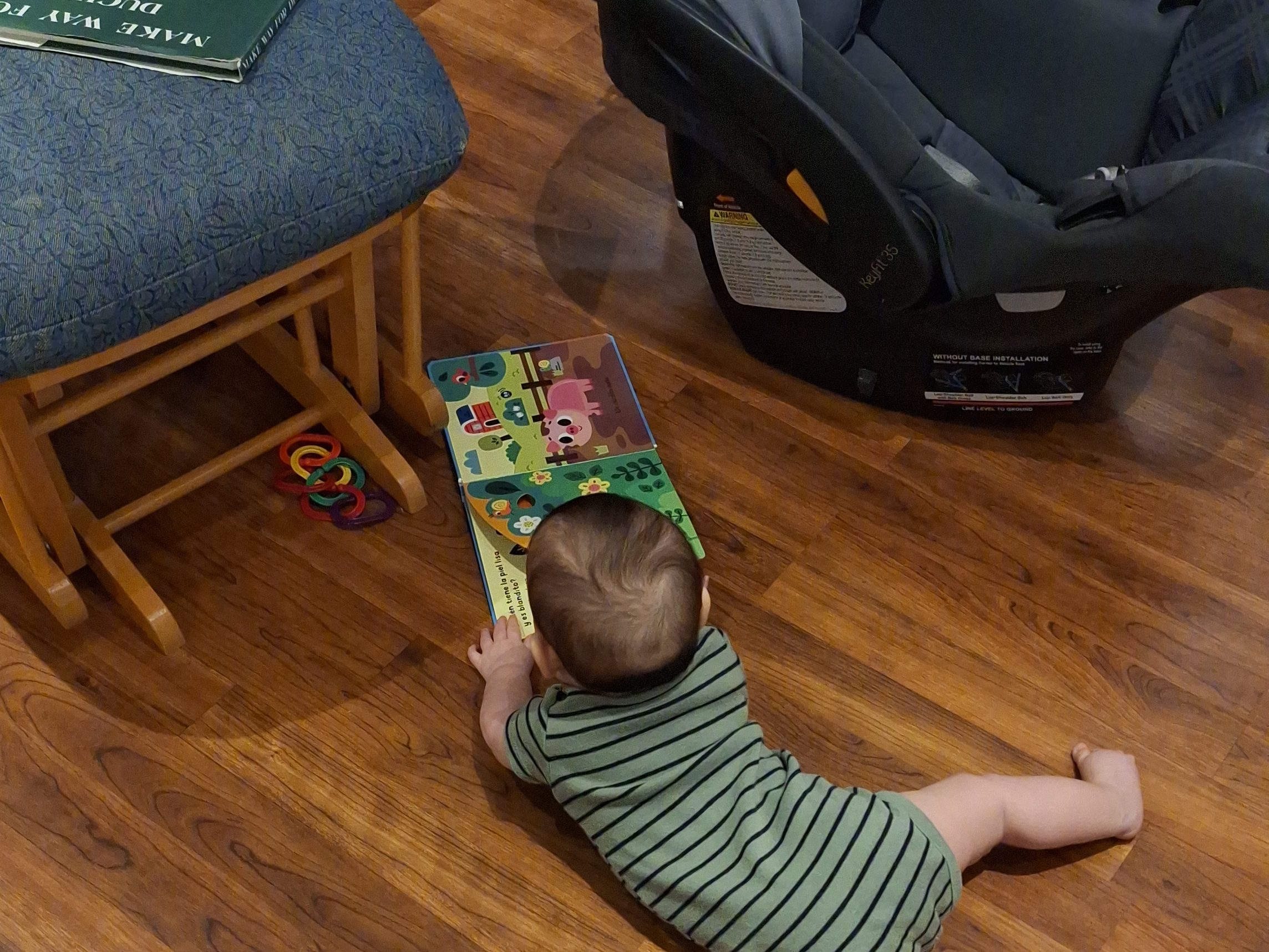
My baby loves loves loves to army crawl (at this point) after a book on the floor. When he gets to it, he picks it up, puts a corner in his mouth, rolls around with it, or opens the pages. I love that books are a valid toy option to him!
What’s even better is how he has started to recognize his favorite book just by the cover. It’s magical to me to see him find joy in reading even under 12 months of age.
Have you found some great ways to read to your baby in their first year of life? Comment below!
Do you have a parent-friend who could use these suggestions? Share this post with them and have them follow me for more tips on raising kids who love to read.
 a Look at a Book
Leave a comment