…that will make you look forward to reading with your child!
How do you feel about reading picture books with your littles?
My son is just starting to get into the phase where he has ONE favorite book that he asks us to read to him multiple times per day. Currently, his book of choice is Caps for Sale by Esphyr Slobodkina. I made it fun by having him act out what the monkeys do in the book, and he also enjoys the “Tsz! Tsz! Tsz!” sound that the monkeys make each time. I apparently made it so fun that it’s the only book he reaches for off the bookshelf during the day.
Being in this phase with him is reminding me of why it’s so important to stock your house with picture books that are enjoyable for both your kid(s) and you.
That’s something I didn’t know when I was a kid who preferred chapter books. While I could enjoy reading picture books to those younger than me at times, some nearly bored me to tears.
At the time, I didn’t know why some books were better than others in the realm of children’s literature. I just knew the books that I didn’t like. I mean, how interesting can a “My First Animal Book” be after three times through? Or those books with a different picture for every letter of the alphabet?
Now, as a new mom, I’m not knocking those baby books. My little guy is all about the touch-and-feel books at the moment. Those have their place, they are important, and there are ways to spice them up for yourself as the reader. I’ll talk more about that in another post. But not all of those “baby books” are created equal, as I’m sure you know.
It wasn’t until college in my Children’s Literature class and my class on early literacy that my view of picture books changed from disdain to downright awe and respect. My professors helped me see the beauty and power of good children’s literature.
Now that I’m a mom, it’s all coming back to me full force, and I am glad that the books we have on the shelves are ones that hold up to many re-readings.
So what makes a kids’ book worth reading?
I thought about writing titles that fit under each of these traits, but I decided that I’d rather give you the tools to assess books that you encounter. After all, while I’ve read extensively compared to some, there are always new books that might be incredible that I don’t know about.
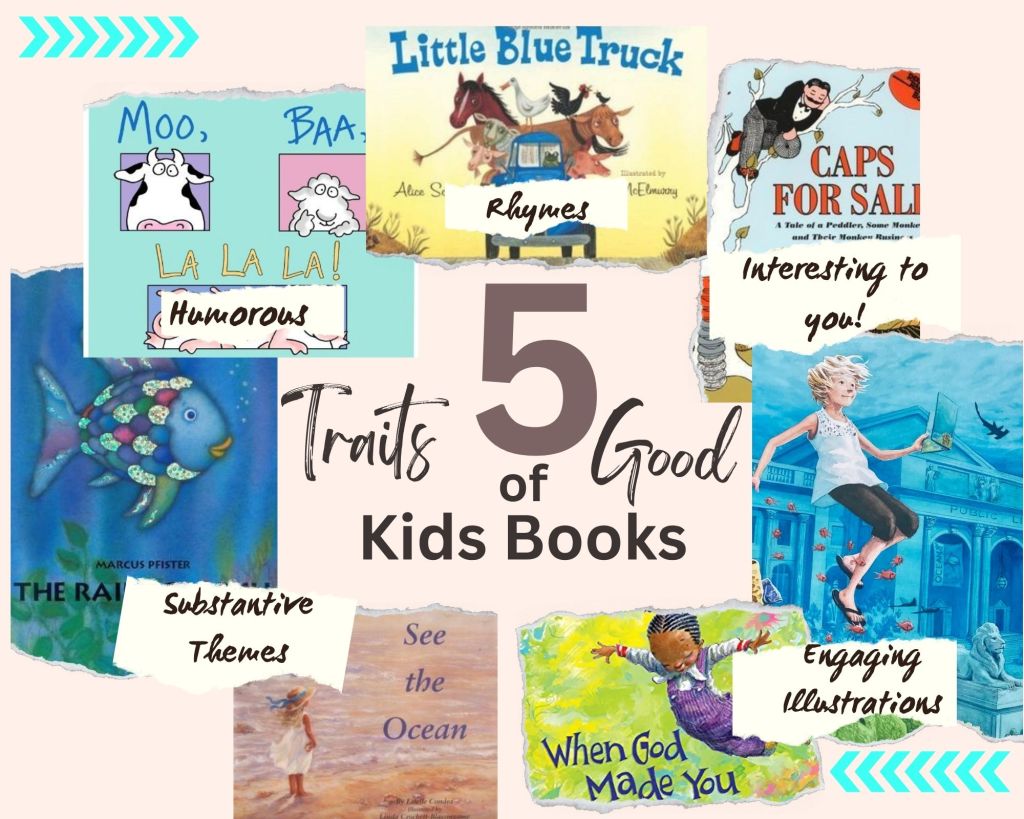
So here are 5 traits to look for when deciding if the book you have in your hands is one that you’ll still enjoy after the 20th time of reading it to your kid.
While this list is not exhaustive, of course, it helps to look for some combination of the following in the books you read to your kids:
- Contains Humor – Children develop a sense of humor quite early on. Most babies smile before they’re two months old and laugh for the first time between 4-6 months old (NIH). Books that make your child laugh will likely make you laugh, and the joy that blossoms as you share in laughter will both strengthen your bond and create positive associations with books in your little one’s brain. Contrary to what I thought as a kid, humor can exist even in board books!
- Has Engaging Illustrations – The images in books serve multiple purposes. As a chapter book reader, I thought any books with pictures were too easy. But they actually help so much with comprehension! Let me see if I can describe how. First, they literally help your child “picture” what’s going on in the words they’re hearing. For example, in Caps for Sale, the actions that are described in words are also pictured on the page. When the peddler stomps his foot, my son can see the peddler doing that on the page. When I have him do the action with his foot, it helps reinforce the meaning of the words. The babe is still learning body parts, after all, let alone actions with those body parts.
Language is innate in humans. We have the God-given ability to first hear and understand language – like my one year-old, then speak it, then read it. In that order. But their eyes have been sending input to their brains since they could open them, so seeing something drawn on the page helps them understand in a way that just hearing the words will not, especially when they’re still developing language in those toddler and preschool years (and into elementary school).
Another purpose of illustrations can be simply to be beautiful. Not all are, you know. However, when you discover books that are basically artwork in book form – you know, the kind where you go “Wow, these illustrations are gorgeous!” – they help readers connect more to the story, inspire their imaginations, and enrich our lives simply by being beautiful. - Rhymes or has rhythm – turns out that Dr. Seuss was on the right track with all the rhyming nonsense words he used in his books! Far from being just silly, rhyming has been shown to be a powerful method for helping children absorb and understand language. Recognizing rhyming words is even a milestone marker that kindergarten teachers look for in their students, and it gives them information on where the child is in their literacy development.
Beyond the importance of rhymes, though, they’re plain ol’ fun! And we want kids to associate reading with enjoyment and fun because brains learn better when they’re having fun. Dr. Seuss isn’t the only author who rhymes, though, so you’re not limited to Hop on Pop and “Sam I am.” Look for books that have a sense of rhythm and musicality to them, along with rhyming (examples below).
Books don’t have to rhyme to be a quality children’s book, of course. Some books simply have a musicality or a rhythm to them that make the words ripple off of your tongue. Sometimes you can tell the author was trying to make the book poem-like. Other times, it’s just a lyrical type of writing in the way the words flow, or phrases repeat, etc. Often, I come to appreciate these books after reading them a few times with my child, because the familiarity helps me recognize the flow of the words. - Contains a Substantive Theme – By this, I of course do not mean a college level theme of searching for identity or overcoming the trauma of a loss (necessarily). But quality books will often have a message or theme woven in seamlessly that enriches our hearts and minds – without trying too hard or making it blatantly obvious. Often, the books that fit this description also check off the other boxes on this list as well.
For kids, these message are often ones about kindness, being helpful, seeing another’s point of view (empathy), being a good friend, sharing, etc. You know, essential life skills and character traits that we want to instill in our kiddos. - Is Interesting to You (the reader) – this one might be a stretch for some books. In general, though, you’re looking for books that you like reading to your child. When you’re reading together, the book needs to be interesting for both parties. Otherwise, your child will pick up on the fact that you think it’s boring and will not get the pleasant association with reading that you’re hoping for them to have.
If the book isn’t inherently interesting, I find ways to make it interesting. For instance, we have a book called How I Feel. But each page simply has one word (the emotion) and a photo of a kid expressing that emotion with their face/body language. That’s boring to me after the first read. But my son loves the photos and the expressions on their faces. So I decided I would “read” it with complete sentences or add questions. I even translated it into Spanish so he was hearing the other language of his heritage. Then, I make the same facial expression that the page shows, which my little guy loves.
Another way I make an uninteresting book more interesting is with my voice. I change the intonation, use an accent, or make the animal sounds more “real” than the onomatopoeia sounds on the page. When I do this, he often laughs. In this case, reading it in an engaging way for him makes reading it enjoyable for me.
Other times, the author may just be good enough that the way the content or story is presented is interesting to the reader. Take, for example, Sandra Boynton books. She makes all the “boring” things for adults, like counting and opposites, into an engaging text through her illustrations and the way she presents it (e.g. each dog having a different dog sound as you count up to 10). When the vocabulary and sentences are not boring for me, I enjoy the book, plus I’m exposing my son to lots of language while he enjoys looking at the pictures.
I hope that these markers give you a framework for how to evaluate books you’re considering for your pre-reader, whether the books are new, used, or borrowed!
However, to give you some ideas to get started, here are some of my favorite titles that meet most (if not all) of these standards. Each title is linked to its Thriftbooks page in case you’d like to buy a copy for yourself or a friend.
Speaking of links . . . This post may contain affiliate links which help cover the cost of running this website. At no extra cost to you, I’ll receive a commission if you purchase through my links. Please read full disclosure for more information.
Board books:
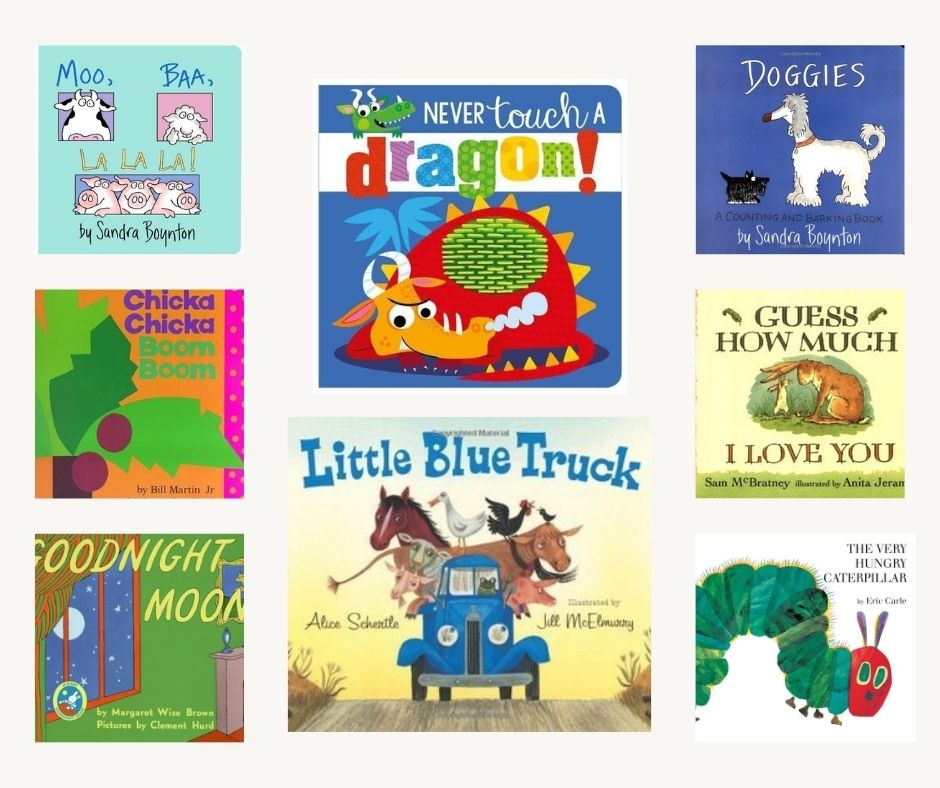
- Never Touch a …. Series: these touch-and-feel books give a different twist to the typical animal touch-and-feel. You’re more likely to find spiky spiders, flaming dragons, and wide-mouthed alligators in these books rather than soft kittens and woolly lambs. Plus, they tend to rhyme, have bright and colorful illustrations, and plenty of humor. Never Touch a Dragon was given to us when my little boy was born, so we recommend starting there!
- Sandra Boynton books – the illustrations aren’t beautiful artwork, but they are engaging. The books are humorous, keep my interest (enough) even after multiple readings, and I know plenty of kiddos who love these books. I like that she adds in additional words beyond the main content (numbers, opposites, animals, etc.) Doggies and Moo, Baa, La La La! are favorites at our house.
- Eric Carle’s The Very Hungry Caterpillar – it’s engaging for kids and tells a complete story, rather than having an I-cut-it-short-for-the-young-mind feel. The lengthening pages make it interesting for the little tyke listening, along with the holes that show where the caterpillar ate through the food.
- Brown Bear, Brown Bear, What Do You See? – lots of rhythmic repetition with Eric Carle illustrations, plus animal and color words = a favorite book for kiddos
- Chicka Chicka Boom Boom – this one I stumble a bit on some pages as I try to find the rhythm that was obviously intended. However, it creates a story that involves all the letters of the alphabet, has both upper and lowercase letters, and the illustrations help little ones pictures the action (a band-aid on one letter when it fell, another letter being twisted up, etc.).
- Goodnight Moon – I love how the great green room gradually darkens as you say goodnight to everything in it.
- Guess How Much I Love You* – a sweet message and also can include the baby’s body if you reach up and out when Little Nutbrown Hare and Big Nutbrown Hare do.
- Little Blue Truck* – animal noises are more interesting with a story, especially one that rhymes so creatively. For some reason I didn’t know this book until it was given to us as a baby gift, but I’m glad it’s in our library! There is also a series of them, though I haven’t read the other ones yet.
*Also available as picture books
Picture Books:

- Madeline – with lots of real places in Paris to look at in the illustrations and rhyming all throughout, this book packs a literary punch. It includes a big event in some kids’ lives (appendicitis and emergency surgery) with natural kid reactions to the event when they see the special treats Madeline received (“We want our appendixes out too!”).
- Rainbow Fish – Rainbow fish does learn a very clear lesson in this book. But it’s a valuable one: sharing and having friends is more important than being beautiful/having the most of something. The illustrations are fascinating with the glittery scales that Rainbow Fish has, and the lighting of the images gives an underwater feel.
- See the Ocean – A lesser-known title, perhaps, but the illustrations in the book, especially of the ocean, are beautiful pieces of art. This book can teach so many valuable skills for reading, especially inference! It tells the story of a family of 5 going on vacation and how the two boys always compete for the first glimpse of the ocean. Their little sister, however, is content to sit in the middle and listen, until one trip, she declares that she can see the ocean before it’s even visible. The boys cry out that it isn’t fair because she can’t see it. The inference that must be made is that she cannot see at all, yet she “sees” it in her mind in the most poetically picturesque way. It’s a picture book favorite of mine, for sure.
- Thundercake – Patricia Polacco is another author who nails children’s literature. She takes a normal childhood fear (thunderstorms) and makes a recipe to help kids manage their fears. I believe Ms. Polacco based this book off of her childhood, because there is an actual recipe for thundercake in the back of the book. I love this book for its emotional relatability and its message of facing your fears.
- Make Way for Ducklings and Blueberries for Sal – Robert McCloskey uses “plain” illustrations in that they’re two-toned. Yet for little eyes, that can help simplify where they need to focus. In fact, for moms of newborns, try reading out loud during tummy time and let them take a look at the illustrations. I love the musicality of the names in Make Way for Ducklings and the repetition of the sound of the blueberries hitting the bottom of the pail in Blueberries for Sal. Mr. McCloskey does a superb job of making the settings of these stories accessible for kids, whether or not they’ve visited Boston’s Central Garden or picked blueberries themselves.
- Rosie Revere, Engineer and the other books in the series are fantastic. They have great rhyme and rhythm, tell fun stories, and have illustrations that immerse you in the world of each girl. I also love that it specifically aims to normalize girls being scientists, mathematicians, engineers, etc.
Looking for more picture book recommendations? Here are 10 Authors and Illustrators worth your time, as well as plenty of read-aloud suggestions.
Happy Reading!
 a Look at a Book
Leave a comment